
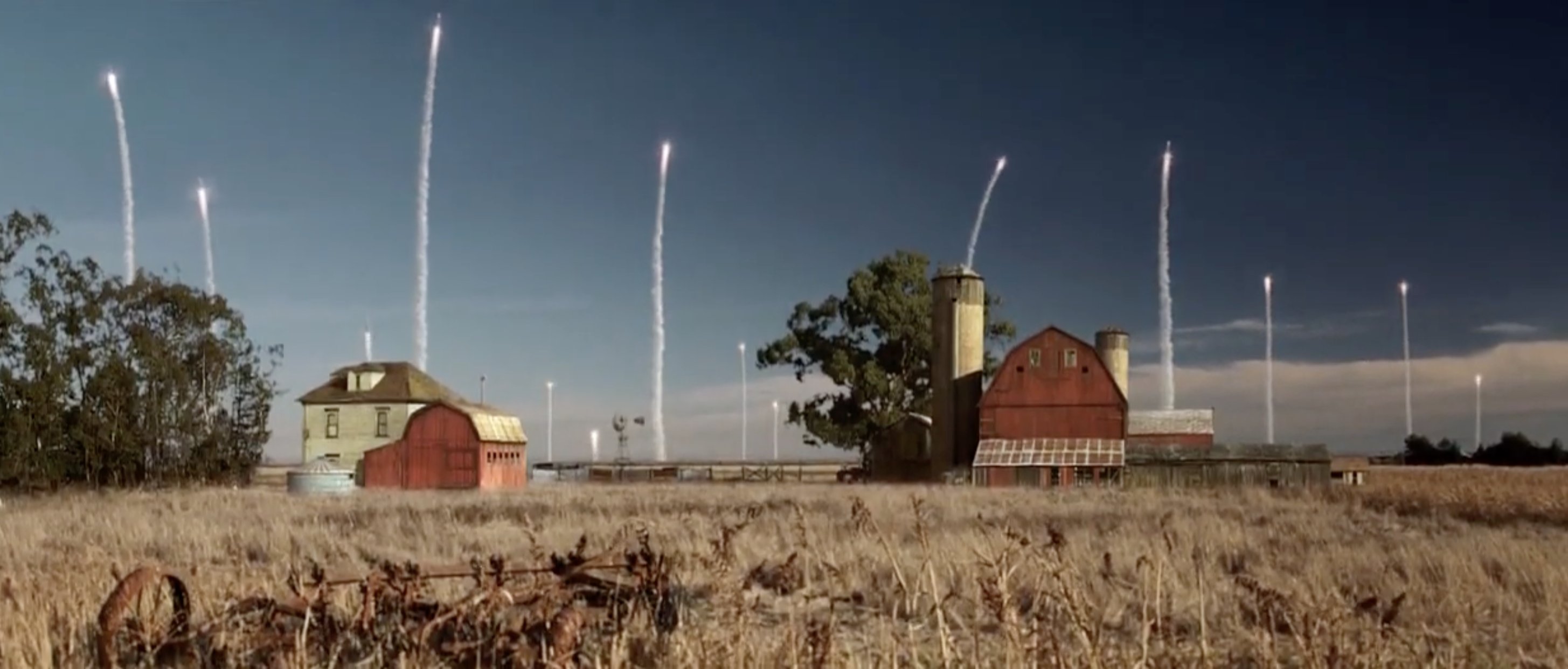

Top photo: Still from "Terminator 3: Rise of the Machines". AI-Skynet launches nuclear missiles.
Right: On September 26, 1983, Lieutenant Colonel Stanislav Petrov saved the world from nuclear war. Still from the film “The Man Who Saved the World”. Petrov and Robert de Niro.
Press release: Judgment Day - Nobel Laureates warn about AI and nuclear weapons
„There is no greater obligation than to prevent the catastrophe of nuclear war“
Amidst the global hype surrounding the widespread adoption of artificial intelligence, we are witnessing a new nuclear arms race and a rush to expand existing uranium mines and develop new ones in the US, Canada, Brazil, and other countries. This is the grim backdrop to the upcoming International Uranium Film Festival events next October 2026 in Düsseldorf & Berlin in Germany, and in Spring 2027 in Las Vegas in Nevada.
„Humanity stands at a defining moment in its history. More than eighty years after the dawn of the nuclear age, and at the threshold of the age of artificial intelligence, we are presented with an unprecedented challenge“, states the in July 2026 signed „Rome Declaration“ of the Global Nobel Laureates Assembly on Artificial Intelligence and Nuclear War. „In the midst of a worsening nuclear arms race, we are embarking on an equally dangerous AI race. AI built into nuclear systems leaves little time for, or even replaces, human judgement in a crisis.“
The situation facing the world today is serious. Perhaps even more serious than during the 1962 Cuban Missile Crisis between John F. Kennedy and Nikita Khrushchev. Back then, artificial intelligence was still pure fantasy. It did not yet exist. In October 1962, the decision for a nuclear attack still had to be made manually by the President. We were lucky. Neither Kennedy nor Khrushchev pushed the so called Red Button.
About 20 years later, September 26, 1983, the „Red Button“ for the launch of nuclear weapons and the start of a nuclear war was in the hands of a Russian soldier: Lieutenant Colonel Stanislav Petrov of the Soviet Air Defense Forces. 44 years old Petrov was on duty, monitoring the early-warning satellite computer system at a secret command center near Moscow. Suddenly the system detected five U.S. Nuclear-armed intercontinental ballistic missiles attacking the Sovjet Union. The lieutenant colonel had about 20 minutes to—literally—push the "red button" and launch the counterattack before the US missiles struck Russia. But Petrov didn't believe the computer. He suspected a technical error and decided to disobey the official protocol and reported the alert as a false alarm up the chain of command. In doing so, he saved humanity.
As we know now: Petrov was correct. The satellites had mistakenly interpreted the reflection of sunlight off the clouds as attacking missiles. The brave Russian soldier became „the man who saved the world“, because he didn't trust his computer. Three well done and awarded movies tell Petrov’s heroic story: „The Man Who Saved the World“ by Peter Anthony and „The Red Button“ by Miroslaw Grubek and Ewa Pieta, and the short animation "In Our Hands" by Camillo Sancisi.
Just a year later — unaware of the events that took place in Russia in 1983 — Hollywood director James Cameron released a successful science-fiction war movie starring Arnold Schwarzenegger as "The Terminator." While not everyone likes action movies and blockbusters, they have the potential to reach millions of people - and sometimes they're prophetic and have a serious warning message for humanity.
In the Terminator series, the US Department of Defense handed over control of US defenses and nuclear weapons to Skynet—an artificial intelligence program— in order to save the planet. Skynet subsequently classified humanity as the greatest threat to the planet. Since nuclear war is the quickest way to kill millions of people, the AI system launched US nuclear missiles at Russia, prompting a Russian counterstrike. Only a few humans survived, facing a final war of extermination against robots.
The current hype surrounding artificial intelligence makes this catastrophic scenario possible today. In 2023, speaking at a press event in Los Angeles, Arnold Schwarzenegger said James Cameron’s 1984 science fiction has now become a reality. “Today, everyone is frightened of it, of where this is gonna go,” Schwarzenegger said about AI. “And in this movie, in ‘Terminator,’ we talk about the machines becoming self-aware and they take over… Now over the course of decades, it has become a reality. So it’s not any more fantasy or kind of futuristic. It is here today.“
Two years later, in 2025, during an interview with Rolling Stone, director James Cameron warned: „I do think there’s still a danger of a ‘Terminator’-style apocalypse where you put AI together with weapons systems, even up to the level of nuclear weapon systems, nuclear defense counterstrike, all that stuff,” Cameron said. “I feel like we’re at this cusp in human development where you’ve got the three existential threats: climate and our overall degradation of the natural world, nuclear weapons, and super-intelligence,” he added.
Also in 2025, the Nobel Laureate Assembly for the Prevention of Nuclear War stated in its Declaration to the world Leaders and the general public: „Our survival and the survival of future generations are at stake. There is no greater obligation than to prevent the catastrophe of nuclear war. The threat of nuclear war is indiscriminate.“
The Nobel laureates write further: „ We can’t reduce nuclear risk by working in academic or policy silos. The public must be part of the effort. Understanding that the lack of political will impedes the reduction of nuclear risks, we call on scientists, academics, civil society, and communities of faith to help create the necessary pressure on global leaders to implement nuclear risk reduction measures. Nuclear risk is not a challenge to be left to the future or passed to another generation. It is ours to confront and ours to reduce.“
Since its inaugural edition in 2011, the International Uranium Film Festival (IUFF) is trying to do its best to informing the general public about nuclear risks and consequences through films and open discussions, and to preparing the humus for a safer and more just world. The film festival founders and directores strongly share the view of the Nobel Laureates: „There is no greater obligation than to prevent the catastrophe of nuclear war.“
Attend the upcoming screenings of the Uranium Film Festival on October 11 in Berlin (Prenzlauer Berg, Lichtblick-Kino) and on October 17 in Düsseldorf (Bambi Filmstudio). The Las Vegas edition of the Uranium Film Festival is scheduled for Spring 2027. Any support is welcome.
Norbert Suchanek and Márcia Gomes de Oliveira, Directors and Founders of the International Uranium Film Festival and Nuclear-Free Future Laureates 2025.
Contact
norbert.suchanek@ uraniumfilmfestival.org
Rome Declaration - Humanity at the Threshold: A Declaration on Artificial Intelligence and Nuclear Weapons
The Nobel Laureate Assembly Declaration for the Prevention of Nuclear War