
2nd CHICAGO INTERNATIONAL URANIUM FILM FESTIVAL, April 24 - 26, 2026
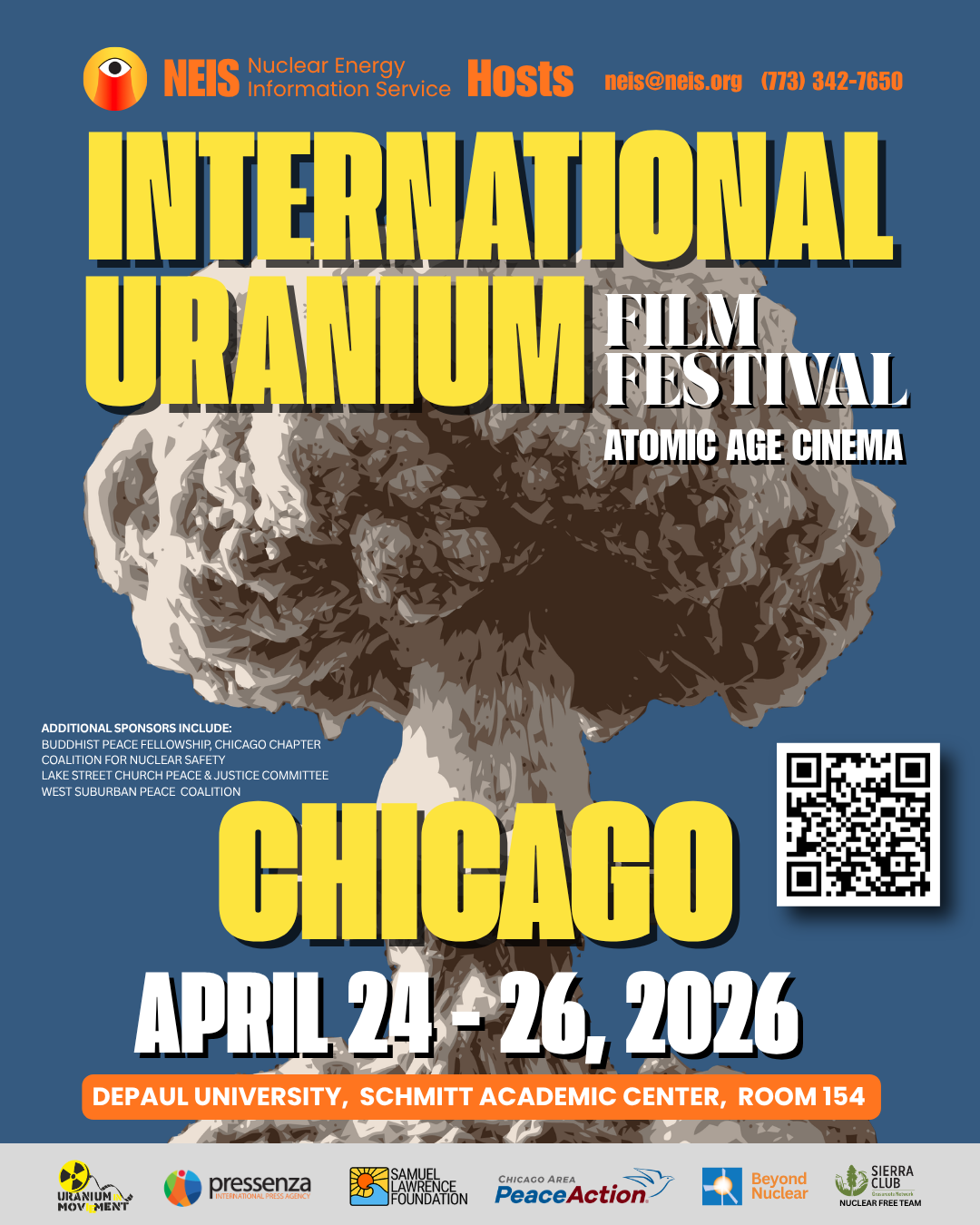
The International Uranium Film Festival 2026 in Chicago is scheduled for Friday through Sunday, April 24-26, to coincide with the 40th anniversary of the Chernobyl disaster. It will be held at DePaul University, Lincoln Park Campus, Schmitt Academic Center, Room 154. The event is entry free and open to the public. The Festival is the second held in Chicago – the first being in 2024. Its genesis is from 15 years ago in Rio de Janeiro by film activists Norbert Suchanek and Marcia Gomes de Oliveira, who received the Nuclear-Free Future Award in 2025 for their achievements in working for a nuclear-free world.
The festival is dedicated to creating public awareness about the hazards of nuclear weapons, power and waste; and to giving voice and space to those peoples directly affected by the hazards of the Nuclear Age. This year’s film topics span the entire nuclear-related spectrum, including films about nuclear weapons and war, nuclear power and waste, uranium mining, and victims of the Nuclear Age.
FILM LIST
Atomic Bamboozle: The False Promise of a Nuclear Renaissance
USA, 2023, Director Jan Haaken, Documentary, 47 min. www.atomicbamboozle.com
As pressure mounts in the US to meet net zero carbon goals, the nuclear power industry makes its case for a nuclear “ renaissance” to solve the climate crisis. In place of the highly costly reactors that have been shut down across many regions of the country, investors began in the early 21st century to promote small modular nuclear reactors (SMRs) as a technological solution.
The film follows anti-nuclear activist Lloyd Marbet and attorneys Greg Kafoury and Lauren Goldberg as they draw lessons from the decades-long fight to shut down the Trojan Nuclear Power plant in Oregon and expose current campaigns to revive the industry. Climate activist Cathy Sampson-Kruse (Waluulapum member of the Confederated Tribes of the Umatilla Indian Reservation) points to the buried legacy of atomic weapons production and nuclear power generation at Hanford Nuclear Reservation in Washington State and to its devastating impacts on tribal communities.
University of British Columbia professor M. V. Ramana, a physicist and internationally recognized scholar on nuclear power, traces the history of nuclear power generation from the 1950s to the present and takes up four main problems – costs, accidents, waste and proliferation – and shows how the industry continues to deny or disavow these persisting problems in the much heralded generation of ”new nuclear.” Film Info: https://www.atomicbamboozle.com
Bombshell
USA, 2025, Director: Ben Loeterman, Producer: Ben Loeterman and Gaia De Simoni, Narrator: Ann Curry, Documentary, 80 min
BOMBSHELL explores how the U.S. government sought to manipulate the truth about the Manhattan Project and the bombings of Hiroshima and Nagasaki during World War II. By co-opting the press, it presented a benevolent picture of atomic power, minimizing the horrific human toll of the bombings. Bombshell sheds light on the efforts of a group of intrepid reporters to let the world know the truth.
Ben Loeterman is an acclaimed filmmaker of current affairs and historical documentaries, mostly for PBS series, but also for the BBC, Sundance Channel and others. Loeterman produced for the current affairs series FRONTLINE for twenty years from its inception in 1982, earning national Emmys for investigative reporting and directing.
In 2020, Ben first began to imagine BOMBSHELL while reading a new biography of hislongtime journalistic hero, John Hersey of the New Yorker. Hersey's article, "Hiroshima," in 1946 is now widely considered the best piece of American journalism and the forerunner to the New Journalism of the 1960's practiced by Truman Capote, Joan Didion, Hunter S. Thompson and Tom Wolfe. Loeterman began exploring not just Hersey, but the context of his reporting in the year after the nuclear strikes and before Hersey's piece stunned the world and forced a soul-searching of America's moral culpability through a novelistic weaving of six survivors in Hiroshima. Film info: www.blpi.tv/bombshell/
Chernobyl: The Lost Tapes
UK 2022, Director: James Jones, Producers: Serhiy Solodko and Sasha Odynova, Top Hat Productions in association with Sky Studios, Executive Producer: Darren Kemp, Feature Documentary, 96 minutes, English
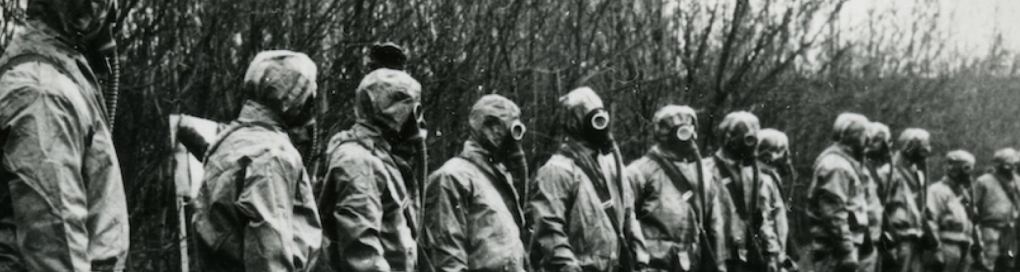
Thirty-six years after the Chernobyl nuclear reactor exploded in Soviet Ukraine, newly uncovered archival footage and recorded interviews with those who were present paint an emotional and gripping portrait of the extent and gravity of the disaster and the lengths to which the Soviet government went to cover up the incident, including the soldiers sent in to “liquidate” the damage.
Chernobyl: The Lost Tapes is the full, unvarnished true story of what happened in one of the least understood tragedies of the twentieth century. Winner of Cinema Eye Honors Award; Royal Television Society Craft Award for Sound; Broadcast Tech Innovation Award for Best Audio Postproduction.
“Superb, compelling… Extraordinarily powerful… James Jones’ gripping, disturbing documentary tells a story not only of radiation catastrophe but of lies, fear and exploitation.” The Observer. / “The best thing I’ve seen since Chernobyl” The Guardian
Film Info: ´www.tophat.tv and www.jonesfilms.net/chernobyl-thelosttapes
Nagasaki Journey (Digitally Restored Version)
Japan/USA, 1995/2025, Directors & Producers Chris Beaver & Judy Irving, Digital Restoration: Gary Coates, Documentary, English/Japanese, 30 min.
Produced by Emmy Award-winning filmmakers, Nagasaki Journey is a powerful, yet hopeful look at the immediate and continuing aftermath of the atomic bomb dropped August 9, 1945, on Nagasaki, Japan. The film tells the moving personal stories of two Japanese survivors and a US Marine, who was one of the first American troops to occupy the city after the war ended. All three dramatically reveal how the impact of this single bomb forever transformed their lives and their thinking. Despite the enormous wartime tragedy, their common humanity transcended previous hatreds, providing hope the Nagasaki bomb would be the last atomic weapon ever dropped in warfare. The primary collaborators on the project were Shogo Yamahata, Rupert Jenkins, Maya Ishiwata, Michael Levin and Hannah Koopmann.
„Nagasaki Journey (Digitally Restored Version)“ received in 2025 the Uranium Film Festival’s Memory Award for the restoration of a powerful historical documentary film that connects todays young generation with the suffering of the young atomic bomb victims of Nagasaki.
„We accept the Memory award with gratitude on behalf of the people who appear in our film: Sumiteru Taniguchi, Victor Tolley and Itsuko Okubo, whose voices and testimony continue to be heard and reverberate beyond the time of their passing. We are grateful to the Uranium Film Festival for keeping their voices present and alive for this generation and generations to come. The continuing question raised in our film is whether Nagasaki will be remembered as only the second city to be destroyed by a nuclear weapon, or whether it will be the last.“ Judy Irving and Christopher Beaver.
Film Info: cbfilms.net/portfolio-item/nagasaki-journey/
NAMIBIA, BRASIL
Brazil, 2006, Directors: Miguel Silveira and Elias Lopez-Trabada, Fiction, English with Portuguese subtitles, 10 min. Trailer.
A poetic, childlike approach to the aftermath of the atomic bombing of Hiroshima and Nagasaki. A young Brazilian Namibian tells her father one day after school the story of the girl on the other side of the world who became ill after the nuclear catastrophe that happened there many decades ago. The Japanese girl was only two years old when an atomic bomb was dropped on Hiroshima. At the age of twelve, she finally contracted leukemia and was hospitalized. There she folds a total of one thousand origami paper cranes.
Miguel Silveira's Columbia College Chicago Undergraduate Thesis Film "Namibia, Brasil" is an award winning short film that screened at more than 35 film festivals world-wide including the Cannes Film Festival. Film Info: https://www.miguelsilveirafilm.com/
Filmmaker Miguel Silveira will present his film in Chicago.
Silent Fallout - Baby Teeth Speak
USA/Japan, 2023, Director and Producer Hideaki Ito, Assistant Producers: Rieko Tomomatsu, Naomi Sakai, Sachiko Kamakura, Chieko Watanabe, Narrator: Alec Baldwin, Documentary, 76 min
In 2001, baby teeth were found in the Tyson Valley in St. Louis. They were part of 320,000 baby teeth collected for a project half-a-century earlier. Few people now know that the continental US is radioactive. The US has conducted more than 100 atmospheric nuclear tests at home and more than 100 in the Pacific. Ironically, vast amounts of radioactive material generated by the nuclear tests ended up on U.S. soil. The enormous amount of radioactive material produced by the nuclear explosions was carried by the wind across the continent, where it fell to the ground in rain and snow, contaminating pastures, vegetables and water. Everywhere, there were reports of radioactive contamination.
Milk was a special source of concern, given that it was considered an essential source of nutrition for children. Infants, in particular, are extremely susceptible to radiation. Milk from cows feeding on contaminated pastures contained plentiful amounts of Strontium 90. The strontium entered children's bodies, stayed in their bones, and emitted radiation that attacked their cells. Mothers' nerves were strained to the breaking point. At that point, scientists and mothers in St. Louis launched an ambitious project to measure Strontium 90 in baby teeth to find out if their children were being exposed. The film tells the story of the unknown radioactive contamination of the United States. Written, directed, filmed, edited and produced by Hideaki Ito with the support of a grant from the Agency for Cultural Affairs, Government of Japan. Film director Hideaki Ito is a Japanese television producer and filmmaker. He grew up near Hiroshima. A central figure in Ito’s film is Louise Reiss, a female physician in St. Louis. Along with a group of scientists, she devised the Baby Tooth Survey that was conducted from 1958 to 1970 by Washington University and the Greater St. Louis Committee for Nuclear Information. Film info: https://silentfalloutproject.org/
Taiwaste
Germany / Taiwan, 2022, Director: Patrik Thomas, Producer: The Random Collective, Arthouse Fiction/Satire, Chinese, English subtitles, 25 min. Info: www.patrikthomas.de
As nuclear powered country, Taiwan is constantly facing the issue on how to deal with its nuclear waste. In the late 1970s, Taiwans government decided to store parts of its nuclear waste on Orchid Island, 65km off Taiwan’s southeast coast, home of the Yami people who lived for centuries as an isolated tribe. Being tricked by the government, the tribal chief signed a contract to built a “fish cannery“, which turned out to be a nuclear waste storage site. Now, after more than 30 years of protest by the yami people, the government has a new plan: Every Taiwanese citizen who is using electricity is responsible for the nuclear waste produced and has to store it at home.
„Nuclear power would be so CO2-neutral, if only it weren't for the risk of accidents and the problem of final storage. In Taiwan – as Patrik Thomas tells us in his film "Taiwaste" – the government has now found a solution. If no one wants the accumulated nuclear waste on their doorstep, everyone should simply take in a little bit of it, so the burden is at least distributed evenly. In his short film "Taiwaste," Patrik Thomas uses the creative tools of the documentary film to challenge and unsettle us. Is it real? Is it fiction? We were thrilled and are awarding Patrik Thomas the FFF Bavaria Prize at the Regensburg International Short Film Week 2020 for his film.“ Citation for the FFF Bavaria Award.
The Atomic Bowl: Football at Ground Zero - and Nuclear Peril Today
USA, 2025, Director Greg Mitchell, Documentary, 52 min. / www.gregmitchphoto.com
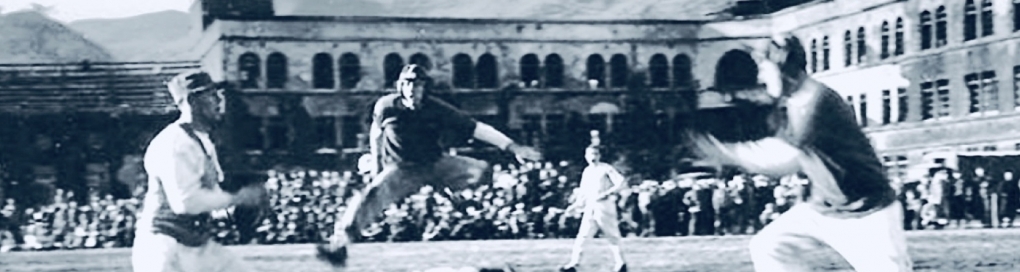
There have been numerous films on The Bomb, even one or two about Nagasaki, but “The Atomic Bowl: Football at Ground Zero — and Nuclear Peril Today” is unique, and with many lessons and warnings for today–as nuclear dangers proliferate and civilian casualties in wars climb even higher. This football showdown featured college and pro stars, on January 1, 1946, and in Nagasaki, near ground zero for the second atomic bomb, which killed over 80,000 just a few weeks earlier.
The film, narrated by Peter Coyote, is not only the first full first-hand account of the game, but a provocative and disturbing story of the decision to drop a second atomic bomb just three days after Hiroshima–and the dangerous message to today’s leaders.
“A master storyteller and urgent reminder of the terrors of nuclear war. Necessary viewing.” Charles P. Pierce, Esquire / “A great movie–a hidden chapter in atomic history revealed.” Jayne Loader, co-director of The Atomic Cafe / “A riveting film, and the topic couldn’t be more urgent. The Atomic Bowl is terrific, and it’s remarkable how much you convey, and how powerfully you convey it, in less than an hour’s running time.” David Sterritt, former chair, National Society of Film Critics. / “Today’s nuclear tensions make Mitchell’s storytelling more timely than ever.” Will Bunch, The Philadelphia Inquirer
To Use a Mountain
USA, 2025, Director Casey Carter, Producers: Colleen Cassingham, Jonna McKone, Documentary, 99 min.
In 1982, the United States began their search for a landfill site for their most dangerous nuclear waste. The Department for Energy at the time preselected six sites across the country. Each of these areas were studied and documented in detail, and their residents consulted. The film, which adopts an observational yet sensitive tone, offers us a topography of these sites and their residents. In Texas, Utah, Mississippi, Nevada, the communities excavate memories of their confrontations with the administration, as well as the distress and outcry that these caused. The film travels across America goes back in time, reminding us that these lands were originally stolen from their first occupants, as we rediscover the intimate links between nuclear, civil and military powers.
The lethal atomic waste piled up across the country in aging facilities destined to decay long before the radioactive materials they contain. Nuclear waste had nowhere to go, until finally in 1982 Congress sketched out a plan: a permanent subterranean disposal site to entomb the nation’s growing stockpile of high-level radioactive waste.
The six communities sitting atop the candidate sites were analyzed in excruciating detail - geology, ecology, hydrology, demography, soil composition, social conditions, regional economy, flora and fauna, and on and on. Nine candidates in 6 states became five; five became three; and from those three, Yucca Mountain was chosen, on the unceded lands of the Western Shoshone Nation, 60 miles west of Las Vegas, on the western boundary of the Nevada Test Site. Film info: https://www.touseamountain.com/
Under the Cloud
USA/Mexico, 2023, Director: Pedro Reyes Alvarez, Producer: Javier Dorantes and Pamela Limon Ross, Documentary, 24 min.
The film examines the ongoing legacy of nuclear violence in the American Southwest, where uranium extraction and nuclear testing have left deep scars on both the land and its people. Featuring voices like Petuuche Gilbert and Adam Jonas Horowitz, the film reminds us that nuclear energy and nuclear weapons are inseparable—a fact that remains dangerously overlooked. „Under the Cloud“ examines the ongoing legacy of nuclear violence in the American Southwest, where uranium extraction and nuclear testing have left deep scars on both the land and its people.
Pedro Reyes Alvarez: „I’ve been working on the issue of nuclear disarmament since 2013 but most intensively from 2019 were the Bulletin of Atomic Scientists commissioned me Amnesia Atomica, as the Bulletin says “we are 90 seconds to midnight”, meaning that we’ve never been closer to experiencing nuclear war ever in human history. I made “Under The Cloud” with the downwinders from New Mexico. Communities that have been affected by nuclear testing but also uranium mining, which made my position a bit more radical since I was first after nuclear weapons and now mistrust also nuclear energy, I just don’t trust mankind with anything radioactive. The urgency of nuclear disarmament is the only alternative to armageddon and also has to do with breaking down the myth that nuclear weapons make you safer. Once you’re aware of these, it is very clear that nuclear energy is not clean nor green, the permanence of radiation for a thousands of years and the impossibility to keep leaks or accidents or explosion under control is impossible, this shows how important can be to see things from the perspective of indigenous world view.“
Pedro Reyes is member of ARTISTS AGAINST THE BOMB: https://artistsagainstthebomb.org/artists
DONATE TO THE FESTIVAL
The festival’s success depends on donations and support from individuals around the globe!
Help us to keep the festival going.


Co-Organizer
Nuclear Energy Information Service (NEIS)
(773) 342-7650 /
(773) 342-7650 /
Festival team
Founders & Directors
Norbert G. Suchanek
Márcia Gomes de Oliveira
SUPPORTER
Samuel Lawrence Foundation
Chicago Area Peace Action (CAPA)
MEDIA PARTNERS
Pressenza
International News Agency
Nuclear Hotseat Podcast
Weekly international news magazine